peacock blue pendant
Serious collector interest in the Peacock Blue pendant is unlikely to reach its full potential until the jewel, or the large Kashmir blue sapphire originally set in it, becomes accessible for examination by a wider section of gemstone traders, specialist collectors and high-budget auction bidders. The pendant carries an intriguing royal association and is reportedly set with an exceptional sugarloaf-shaped cabochon Kashmir blue sapphire, weighing more than 60 carats.
The consistently heard narrative places the pendant within the royal treasury of the Maharajas of Kashmir. According to accounts circulating in gemstone trading circles and some online publications, the second Maharaja, Maharaja Ranbir Singh, presented the jewel to a foreign diplomat, this as the diplomat completed his assignment in Kashmir and prepared to return to his homeland.
Dogra rule in Jammu and Kashmir began in 1846, when Maharaja Gulab Singh established the dynasty's rule following the Treaty of Amritsar. The Dogra dynasty remained in power until 1947, when the princely state's political status changed following the end of British rule in India. Maharaja Ranbir Singh succeeded his father in 1856/1857 and reigned until 1885. His reign therefore falls within the early period of Dogra rule, when Kashmir's royal treasury included valuable jewelry and exceptional gemstones. Fine sapphires from Kashmir and Ceylon (now Sri Lanka), rubies from Burma (now Myanmar) and Colombian emeralds – were some of the treasures in the royal treasury.
The Peacock Blue pendant has not been publicly exhibited in contemporary times, and its subsequent ownership and whereabouts remain uncertain. In modern diplomatic practice, valuable gifts received by government representatives may be subject to national gift-declaration and retention regulations. However, there is insufficient publicly established information to determine how the pendant was handled by the diplomat's country or whether, it entered an official national collection.
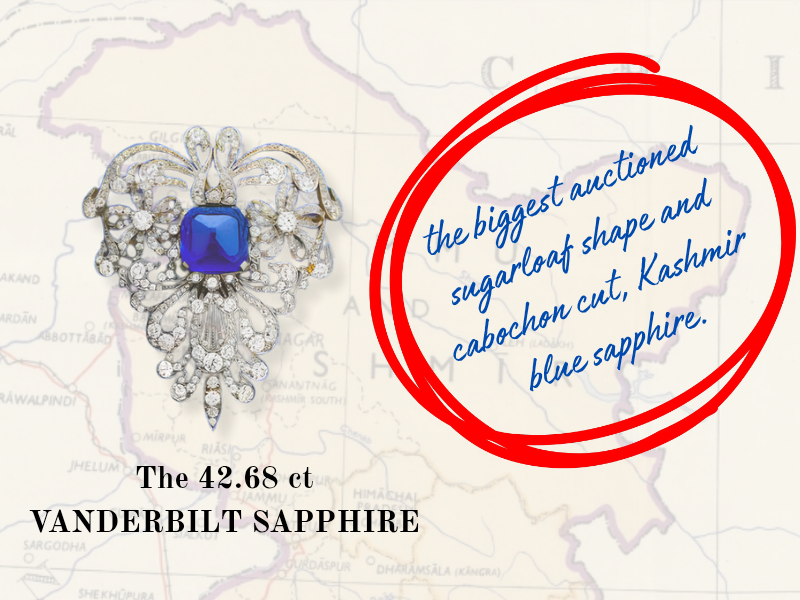
The reported sapphire's weight (60+ carats) makes the story particularly interesting. For comparison, the 42.68-carat Vanderbilt Kashmir sapphire, mounted in a Tiffany & Co. jewel, is a major documented example of a sugarloaf-shaped Kashmir sapphire. It represents an important publicly recorded benchmark for this distinctive cabochon category.
Experienced gemstone collectors also recognize an alternative possibility: the original Peacock Blue sapphire might have been removed, recut, separated from the pendant or even lost. Without physical examination, these possibilities cannot be confirmed or dismissed.
Consequently, the Peacock Blue story remains an intriguing but unverified chapter in Kashmir's gemstone heritage. Its appearance at a recognized auction or before respected gemological specialists, accompanied by independent certification from a globally recognized laboratory such as SSEF, Gübelin or GIA, could transform speculative interest into serious collector attention. Until then, its reported 60-plus-carat sapphire remains an extraordinary possibility rather than an established auction record. For now, the record for the largest Kashmir blue sapphire in this category (shape and cut), will rightly be held by the 42+ carat Vanderbilt Kashmir sapphire.
NOTE: Saw2day does not have any commercial interest in the Peacock Blue pendant or the large Kashmir sapphire that was, set in the jewel. This report is based on online publications and trade talk in the gemstone markets. Investing in high value gems and jewelry, requires a high level of expertise in the specific merchandise. This report is not meant to be an investment guide and should not be used to base investment or purchase decisions.